.png&w=384&q=75)
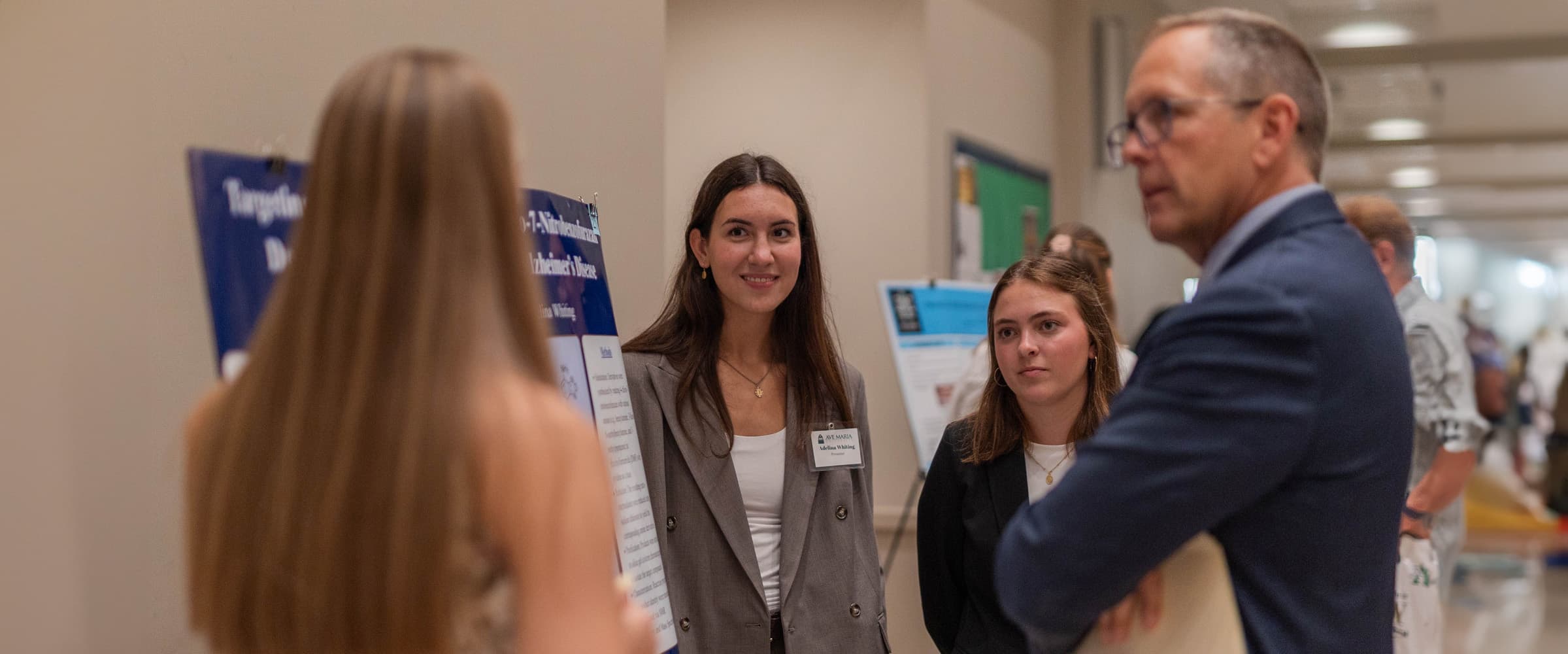
Ave Maria University hosted its third annual Interdisciplinary Student Research Symposium on April 11, 2026, featuring the scholarly work of 83 student presenters from 24 different disciplines. This free event showcased undergraduate research spanning from health science to marine biology to theology, demonstrating AMU’s commitment to fostering academic excellence across all fields of study.
For John Spadaccini, who helped launch the precursor to this event back in fall 2021, the Symposium represents something deeply personal. “Being part of a movement that provides a visible platform for student research has never been about individual recognition—it is about our students and about elevating the academic reputation of Ave Maria University,” he shared. Spadaccini noted that what began as a modest STEM Research Showcase with just seven student presenters has grown into a university-wide celebration of scholarship, now spanning 24 academic disciplines and supported by 19 faculty mentors and 26 volunteer judges drawn from faculty, staff, and community members.
Among this year’s presenters was computer science student Michael Martinez, whose research introduced a novel approach to one of the field’s most foundational data structures. Martinez’s work on “fractal-hash tables” proposes a more efficient solution to the problem of hash collisions—instances where two data keys produce the same index—by recursively generating new hash tables rather than relying on slower conventional methods. The result is a structure that maintains near-constant time performance for most operations while gracefully handling edge cases, offering a meaningful advancement in the theory and design of efficient data storage.
Philosophy student Annie Randolph brought a humanistic lens to one of today’s most culturally pervasive phenomena: therapeutic language. Her research, “To Conceal or Reveal: The Power of Therapeutic Language and the Danger of Losing Sight of the Person,” draws on the work of Martin Buber, Walker Percy, and others to argue that the rhetoric surrounding mental health often reduces individuals to categories rather than honoring them as persons. Randolph proposes dialogue—in the richest, most human sense—as a corrective, one that restores the depth and dignity that systematized therapeutic frameworks can obscure.
The event concluded with a keynote address from Fr. David Pignato, Chaplain and Associate Dean of Mission at Ave Maria School of Law, whose background as a Harvard-trained lawyer and theologian made him a fitting voice for an event at the intersection of faith and academic inquiry. Reflecting on the Symposium’s growth, Spadaccini offered this: “When I gave my fiat to working at Ave Maria University, I committed myself to helping develop the University as a place that values academic excellence by publicly displaying and celebrating scholarly research.”
As the symposium continues to grow, it remains a vibrant expression of AMU’s motto, Veritatis Splendor—“the splendor of truth”—as University students across various disciplines showcase their pursuit of truth and knowledge. Due to the generosity of donors like you, Ave Maria University continues to form faithful Catholic leaders who will go out and change the world.